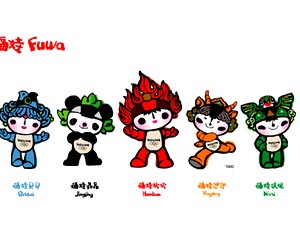
Mascots for Beijing Olympics 2008 are the Five Friendlies or Fuwa, conveying the message of peace and friendship to the world. Beibei is the Fish, Jingjing is the Panda, Huanhuan is the Olympic Flame, Yingying is the Tibetan Antelope and Nini is the Swallow. Each of these mascots has a rhyming two-syllable name, the traditional way of expressing affection for children in China. All five friendlies are also inspired by five Olympic rings. These are chosen in line with the colors of the Olympic Rings.
Distinctive Chinese Characteristics
The mascots have distinct Chinese characteristics, representing the multi-ethnic Chinese culture. They reflect the traditional Chinese philosophy of harmony between humans and nature. The five mascots match the five elements (metal, wood, water, fire and earth) believed by ancient Chinese people to be the base elements of the world.
Symbolism
The fish and water designs symbolize prosperity and harvest in Chinese culture. Beibei mascot is the epitome of prosperity. The fish symbolizes surplus in Chinese culture. It denotes a good year and a good life. The water-wave designs are taken from historic Chinese paintings. Jingjing makes children smile. You could see his joy in the charming naivety of his dancing pose. Design of Jingjing is inspired by panda. Huanhuan is a child of fire, symbolizing the Olympic Flame and the passion of sport. Yingying is a symbol of the vastness of China's landscape. Yingying's flying pose resembles a species unique to the Qinghai-Tibet Plateau, one of the first animals put under protection in China. Nini is as innocent and joyful as a swallow.
Mascots in Olympic
The first mascot to appear at an Olympics was Schuss the Skier during the 1968 Winter Games in Grenoble, France. However, it was not official. The first official mascot was Waldi the Dachshund, which appeared at the Munich Summer Games in 1972. Thereafter, the mascots have become a main element of the Olympic image. They convey the Olympic spirit to the general public. They are popular particularly among children.
Get informed about the mascot for Beijing Olympics 2008, the Five Friendlies or Fuwa, conveying the message of peace and friendship to the world.
Beijing Olympics Mascot
 | |